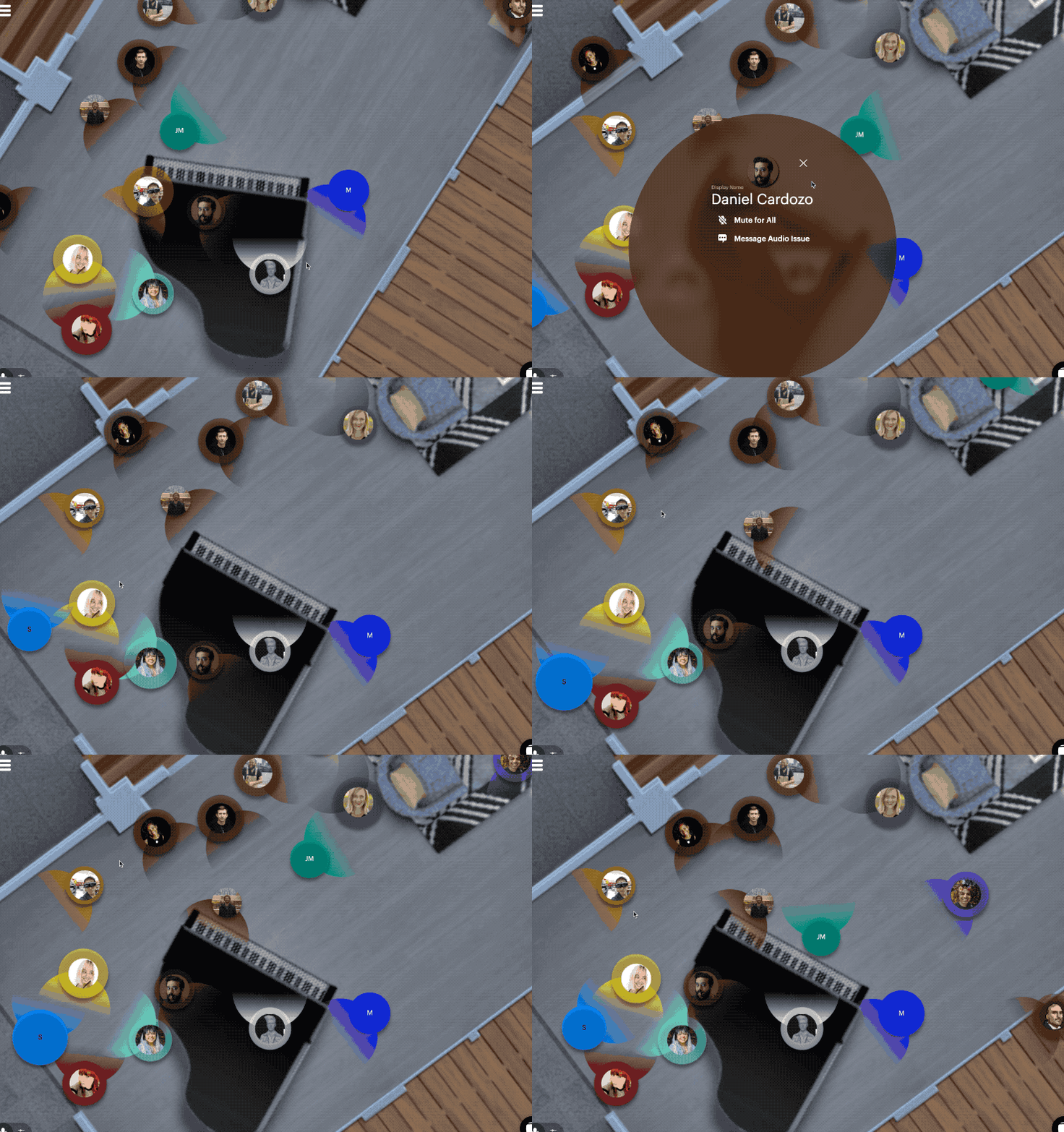
Interaction 11 Photo Highlights

[singlepic id=544]Peter March[singlepic id=545] [singlepic id=546]Jackson Carson [singlepic id=548]John Yuda [singlepic id=550]Carl Aviani [singlepic id=551] Erik Hersman [singlepic id=552] [singlepic id=554] Eduardo Ortiz and Andrea Mignolo [singlepic id=556] Erik Dahl [singlepic id=557] Derek Chan [singlepic id=558] David Farkas [singlepic id=559] Alan Cooper [singlepic id= 560] Ruqian Zhou [singlepic id=564] [singlepic id=566] [singlepic id=568] Christopher Rider [singlepic id=569] [singlepic id=571] Freddy Ferrao [singlepic id=574] James Mulholland [singlepic id=576] [singlepic id=579] Sketch notes by Jason Mesut [singlepic id=580] [singlepic id=582] Brenda Laurel's presentation [singlepic id=585] [singlepic id=586] Jon Kolko

[nggallery id=46] I heard via Twitter that presentations should be up in about a week.

Service Design: More Than The Sum of Its Parts

DESIS Lab Presents
Service Design Performances – Spring 11 Series
SERVICE DESIGN: MORE THAN THE SUM OF ITS PARTS
With Andy Polaine
Date: Monday, February 14, 2011
Time: 6:00 to 7:30pm
Location: 80 5th Avenue, 8th Floor, Room 802, NY
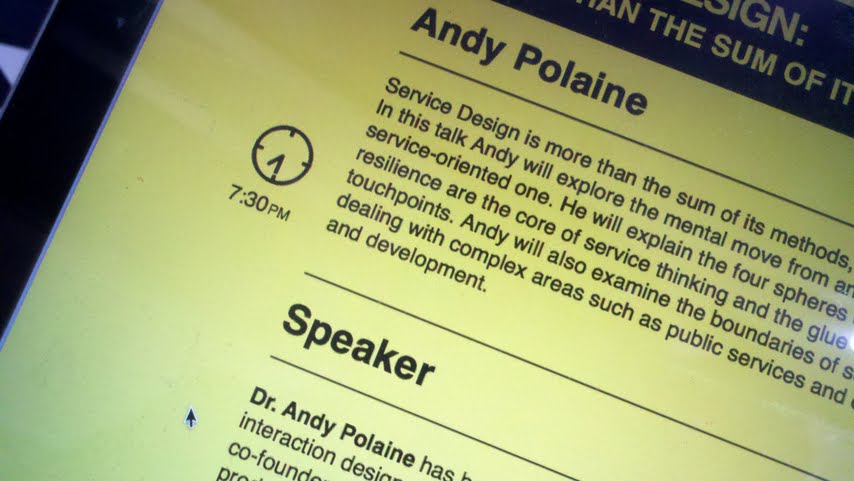
Service Design is more than the sum of its methods, blueprints and customer journey maps. In this talk Andy will explore the mental move from an industrial, product-fixated mindset to a service-oriented one. He will explain the four spheres of people, networks, experiences and resilience are the core of service thinking and the glue that holds together the more recognisable touchpoints. Andy will also examine the boundaries of service design and design thinking when dealing with complex areas such as public services and even international peace, security and development.
Dr. Andy Polaine has been involved in interaction design since the early 90s and was co-founder of Antirom in London. He was a producer at Razorfish, UK and later Interactive Director at Animal Logic, Sydney. He was Senior Lecturer and Head of the School of Media Arts at The University of New South Wales, Sydney before moving to Germany and is now a Lecturer and Research Fellow in Service Design at the Lucerne School of Art and Design in Switzerland. Alongside his academic work Andy continues to work as a interaction designer, service design researcher and is co-writing a book on service design for Rosenfeld Media along with live|work co-founders, Ben Reason and Lavrans Løvlie. [singlepic id=531]
---
Service Design Performances is an immersion experience in design for services, bringing together international professionals and scholars to present their work as well as presenting current and future areas of service design teaching and research at Parsons SDS.
Design for Sustainable Social Innovation and Sustainability (DESIS) Lab is a research lab at the School of Design Strategies, Parsons The New School for Design. Its mission is to advance the practice and discourse of design-enabled social innovation toward more sustainable cities. DESIS Lab conducts research into the ways in which design can enhance community led initiatives in the development of more sustainable ways of living and working. In particular, DESIS Lab uses Service Design as a means to apply design expertise into problem setting and problem solving related to sustainable practices and social innovation.

via School of Design Strategies at Parsons The New School for Design

See Andy Polaine's website here and twitter here.

Cities, Time, and Narratives. Amplified.

The panel focuses on three cities— Dubai, Las Vegas, Bangkok—to interrogate narratives that describe the relationships between cities and time. I could not make the talk as I am at Interaction 11, but here are some photos I took in Bangkok.

[singlepic id=526]Lumpinee Park - features a running track and public weight lifting station, pretty much an open air gym in addition to a nice place for a picnic. [singlepic id=527]Traffic at night. [singlepic id=528]Bed Supper Club. [singlepic id=529]Graffiti. [singlepic id=530]A soccer net mended with old shoes.

Panelists: Brian McGrath, Parsons The New School for Design Aseem Inam, Parsons The New School for Design Stephen J. Ramos, Harvard University Graduate School of Design

Moderator and Contact Person: Scott G. Pobiner , Parsons The New School for Design Scott's Bio

Time: Tuesday, February 8 · 6:30pm - 8:30pm

Location: Parsons The New School for Design / Theresa Lang Community and Student Center Arnhold Hall 55 W.13th St New York, NY

[nggallery id=44]

Large Animal Games

Keynote speaker Wade Tinney, CEO of Large Animal Games and an alumnus of the MFA Design and Technology program, discussed his own journey as game designer and entrepreneur.[singlepic id=524]

play testing, one week bursts,

Real World Lesson #1 (I'm missing lesson #1, if you know it, please comment!)

Real World Lesson #2 Learn from your failures [singlepic id=525] Real World Lesson #3 You're not part of your audience

Real World Lesson #4 Relationships are everything

Real World Lesson #5 Business is a series of design problems.

Event details: May 1, 2010. in the Anna-Maria and Stephen Kellen Auditorium. Parsons The New School for Design presents OneZero, the annual thesis symposium and exhibition of the MFA Design and Technology program. Taking place from April 29-May 2 in the Sheila C. Johnson Design Center at Parsons, OneZero is a series of talks, panel discussions, experiential installations, demonstrations, and screenings of research and work created by budding student artists, designers, programmers, developers, gamers, storytellers, and social entrepreneurs.

Event details source: http://www.artandeducation.net/announcements/view/1092

Ziba - Sunshine Generation - Design At The Edge

Sunshine GenerationBruce Nussbaum brought Ziba's Karen Reuther and founder Sohrab Vossoughi to Parsons on Monday the 7th. They open the presentation with "The revolution is underway." The presentation was based around the "Sunshine Generation" in China, young urbanites that grew up not knowing Tian'anmen's square and have only seen economy growth. [singlepic id=519] Karen Reuther of Ziba says "They call themselves sunshine because they are smiling" Some of what was presented can be related to the article "Oh, to Be a Millennial in China," by AdAge in 2010.

Ziba developed a few findings from their ethnographic research.

1 the youth are comited, their weapon is optimism

2 the shift is radical, and it is happening from the inside out they see china influenceing the world.

3. the scale is unprecedented w 340M 'revolutionaries' participating

One of their main insights was They are more similar than different (with us) Unbridled Optimism - "I don't just want to follow what others are doing. I want to do it myself" they like to "look different together." Anticipating Greatness - "My generation likes challenges. We want something unexpected."

I will post more on this later, including my views in relation to my experiences in China.

[singlepic id=515] [singlepic id=517] [singlepic id=520] [singlepic id=521] [singlepic id=522] [singlepic id=523] [singlepic id=518]

More about Ziba here: http://www.ziba.com/


This lecture is part of Bruce Nussbaum's Design At the Edge lecture series.

Cinemetrics Setup

[singlepic id=497][singlepic id=498] [singlepic id=499] [singlepic id=500] [singlepic id=501] [singlepic id=502] [singlepic id=503] [singlepic id=504] [singlepic id=505] [singlepic id=506] [singlepic id=507] [singlepic id=508] [singlepic id=509] [singlepic id=510] [singlepic id=511] [singlepic id=512] [nggallery id=42]

Happy Chinese New Year - Year of the Rabbit!

It's year of the rabbit! [singlepic id=492] [singlepic id=493]

Myy cousin Clarence Lee designed these stamps for the US Postal Service. See the full set of stamps for the Chinese zodiac here here: http://clarencelee.com/work-stamps-01.shtml

2011 is the second time I've seen the rabbit.

[singlepic id=494] [singlepic id=495] The newest rabbit stamps for 2011!

In New York, "The Empire State Building light up its tower red and gold to celebrate the Chinese Lunar New Year," via Xinhua.

Designing - How & Who - Design At The Edge

Bill Moggridge of the Cooper-Hewitt spoke at Bruce Nussbaum's Parsons class Design-At-The-Edge.[singlepic id=487]

Thoughts on Research [singlepic id=483] ethnographic research latent needs you don't know what the designs are yet market research once you have the concept down and you have a prototype then you can focus on the explicit needs of market research

Intel's Social Networking Experience Prototype "a summary of touchpoints - interesting for a service design or any complicated system" [singlepic id=486] HOW - prototyping inspiration - evolution - validation "every prototype is a failure"

EXPANSION OF DESIGN "We find designers able to deal with more complicated contexts."       designing stuff       design of places - expands to social innovation rather than just structures             designing for social impact - Human

WHO I. The Star Designer "It's a range from an individual effort to a team effort" Lisa Strausfeld - interaction design at Pentagram Frank Llyod Wright - Frank Gehry - who perhaps is the star of modern arch today

II. The Team Design thinking applying the same process but letting non-designers use it having an interdisciplinary team, you find that very difficult problems can be solved ex: a service designed for a visitor from China (Intel UMPC)

III. Crowd Sourcing proposed to be the third group of "Who" ex: esty, wikipedia Open IDEO makes it opaque who is contributing and to what degree, where as Wikipedia does not identify contributors that easily.

SYNTH'D NOTES: Increase your production values as you move up the prototyping stages.

ADDT'L QUOTES: "Venture capitalists tend to start from the business stand point. As designers we tend to start from the popele We have this starting point, it still needs to come to an overlap,...with the business viability"

"the values we have as human beings doesn't really change that much"

"In America we find that people are being forced into courses like math. "You of course being at Parsons have rebelled against that""

PEOPLE MENTIONED Ira Glass - American public radio personality      radio goes through many prototyping iterations Shinichi Takemura - Tangible Earth       he used to be an anthropologist       currently at the Cooper Hewwitt [singlepic id=482] [nggallery id=38]

For more info:
http://www.designing-media.com/download

Framing Matter Flux - updated

"Concepts that become evident in film become applied in our own practicesHow we experience the world and then take that into our [design or professional] practice." Brian McGrath

[singlepic id=489]

matter-flux/open whole "bergson's conclusion...:if the whole is not giveable...it is because it is the Open, and because its nature is to change constantly, or to give rise to something new, in short to endure." "The duration of the universe must therefore be one with the latitude of creation which can find place in it." (Deleuze, Cinema 1,p9) "The real whole might well be...an invisible continuity"." (Deleuze, Cinema i p1_). "Act on it one piece at a time." BM set of information - "a way of looking at an image, not as a picture, but as a set of elements in relation to each other which give you a limited frame of the open whole."

immobile cuts or section: a closed unmoving system/set.

frame - We will call the determination of a ...relatively closed system which includes everything which is present in the image - sets, characters and props - framing." (Deleuze, Cinema_ - "you can't close the whole world out, you can only close out certain information in a frame." BM

movement image - "Movement as physical reality in the external world, and the image, as a psychic reality in consciousness, can no longer be opposed." Deleuze defines the movement image as "the centered set of variable elements which act and react on each other." ( perception image - "set...of elements which act on a center, and which ( objective perception ex: your percept of the room if you are viewing it from the door outside subjective perception - means you're inside the "scene" ex: your percept of the room if you are siting inside it affection image - -we become intimate with these characters, we empathize and identify with them. -less about worldly information and more about the qualities of the individual, the qualities of the face. a close up. thought image has to do with memory reflection image - remembering and reflecting what has happened and overlaying it to what is currently available. (recalling information) -relating the present to the past -by the time it reaches the brain, it is already in the past relation image impulse image- "the energy wich seizes fragments in the originary world." (Deleuze, Cinema 1, pg 124.)" "between affection and action is impulse" action image - "reaction of the center to the set." (Deleuze, Cinema I, p.217) "The action image frames the body in a medium distance shot." sensori motor system - "Bergon states in Creative Evolution that 'the sesnori-motor system' [is] the cerebro-spinal nervous system together with the sensorial apparatus in which it is prolonged and the locomotor muscles it controls," (p. 124). sensori-motor schema - "organizes and coordinates the perceptions, affections, and actions of each living image, and from this schema issues particular configuration of the world..." (Bogue Deleuze on Cinema, p4.) "extensions to our sesnori-motor apparati - ex: digital tools, body practices like yoga or boxing." BM "a schema to help us understand ourselves both as hunters and cyborgs" BM first the hunter develops the skills, the locomoot muslces skills, and then devleops a hunter schema eventually to develop a schema betwn ceberbor spinal nervous sytem _ locomortor muscles. "this is how we can be change detectors and change agents." BM

living image/interva/center of indeterminacy - is the center odf indetermination of a living image, an interval or gap in the universal interaction of matter flows"How do you construct an interior space, a reality from scenes in the film? objective perception/subjective perception - movmeeng images are either objective or subjective.  Objective per is provisionally defined as a point of view from outside the framed set, while subjective perception isd efined as a point of view from within the freamed set. (Deleuze, Cinema 1, pg 71-6) nbsp ex: "you assume you're looking at the wife through the view of the husband's eyes and the husband from the view of the wife's eyes. if the camera assumes that position, it is subjective" BM

"There's something powerful about that camera that just sits there, is meditative and watches the world go by."BM

While he uses static shots, the camera changes places between shots, so in that sense it moves. He is always at right angles to the room he is filming like an architect.

add'l shots - static moving temporal

Change blindness - "sometimes my mind creaties patterns of history, am i seeing reality or am i seeing something i remember." BM

re: using two different ladies in Ozu's film

Films Mentioned: Gaspar Noe's "Enter the Void" 2010

Ozu's.......

Sources: Deleuze, Cinema I BM - Brian McGrath

My Questions: How do you do that when there are shots that aren't just static - like panning and tilting or using a dolly. Why do you want to get the metrics and measurements of the building? Especially when it could be a a set - so it is a partial and fake reality that you then try to define.

[nggallery id=39]